
By Beth Jantz, Senior Vice President
It’s the name that strikes terror and consternation into the hearts of many. Logic model. The name is mysterious. The concept is intimidating. But what is it? And does your organization need one?
What Is A Logic Model?
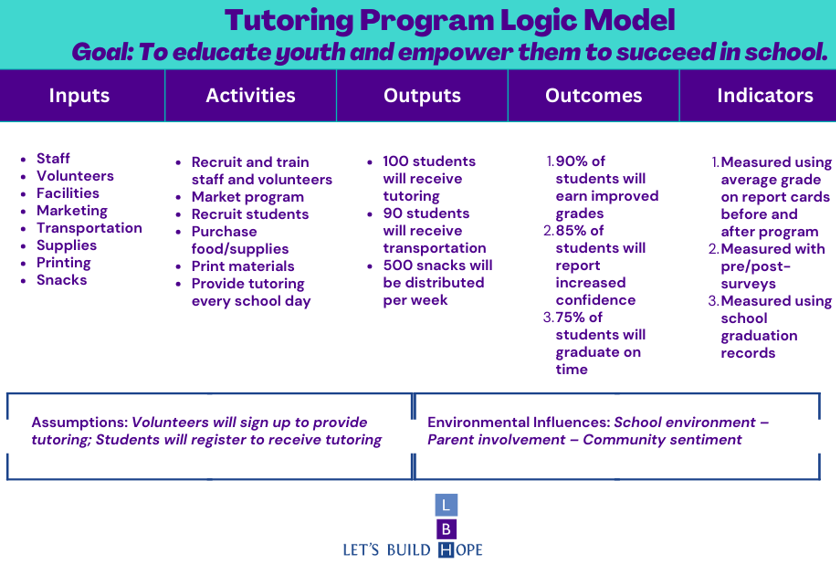
A logic model is a matrix or chart that gives a top-level snapshot of a program. There are countless styles and formats out there, but generally speaking, a logic model is usually a one-page document that includes the following key pieces of information:
- Goal: Broad top-level aim of the program
- Inputs: Resources that are needed to implement a program
- Activities: Actions involved in implementing the program
- Outputs: Countable results of the program
- Outcomes: Measurable changes that resulted from the program
Optionally, some logic models also include:
- Indicators: Measurement tools used to capture outcomes
- Assumptions: List of assumptions the organization is making about how the program will work
- Environmental Influences: List of external factors that could impact the program’s success
Let’s look at a simplified example of a fictional tutoring program.
Why Have A Logic Model?
Logic models have several uses:
Program design
I like to use a logic model to examine a program as a whole and evaluate whether the planned activities will produce the desired results. I ask myself: if my goal is to educate youth and empower them to succeed in school, is it reasonable for me to think that tutoring will result in that outcome? Are there other factors that I should consider and add into my program design? For example, in our fictional tutoring program, the logic model might have helped me realize that I need to add transportation to ensure that students can access the program.
Program evaluation
Logic models are a great place to codify program outcomes and indicators. It’s helpful to have one central place where the organization defines exactly how to measure each outcome so that we are always comparing apples to apples.
Communicating between departments
Logic models are a handy way for the program team to communicate with the development team. As a grant writer, I can pull 90% of the information I need to write a grant directly from a logic model. This cuts down on day-to-day work for the program team and ensures that the development team is submitting accurate funding requests.
Communicating with funders
Some funders request a copy of your logic model along with your grant request. Even if they don’t request it, sometimes it can be a powerful supplemental attachment. The simplicity and clarity of the chart can help funders understand your program – especially if it is more complicated than our example.
I hope I have managed to remove the mystique around logic models for you. Don’t be scared – get out there, partner up with your colleagues, and make your own logic model! You may be surprised how much it helps you understand your organization.
#LBH #LogicModels #GlimmersOfHope #Blog #Fundraising #NonprofitPrograms
Let’s Build Hope teaches logic model creation in its annual Grants Boot Camp – come join us!