
By Linda B. Haley, CFRE, President & CEO
Fundraising demands both our left brain and our right brain. If you’re going to move the financial needle for your nonprofit and motivate your donors to practice their philanthropy with confidence, compassion, and courage, we must be adept at both thinking and feeling. Both are crucial in making your case for support.
Today, let’s focus on feeling. So often, I meet early-career fundraisers who want to share their “pitch” with me. Or I hear from Board members that their nonprofit needs an “elevator pitch.” (Yikes! Elevators are terrible places to ask for support.) What’s askew in both these requests is the idea that a magical “script” is going to be just the thing to inspire and motivate people to support your work. But the truth is: a magic script isn’t a real thing.
The Case for Why
What is the real thing, you ask? It’s your Case for Why, the term we’ve coined at LBH for our version of a case for support: an internal document that explains your organization’s need for annual operating support in a way that reaches both the extrinsic and intrinsic parts of donors.
Crafting extrinsic motivation for your case is fairly straightforward: simply, clearly, and quantifiably explain what you do and why it matters. Push the overhead down into the program costs (for everyone except foundations or the government, who usually don’t allow that), and you’re off!
Inspiring intrinsic motivation, however—reaching someone’s heart, or limbic brain, if you take the scientific route—is a bit tougher. To move someone to give because of how the gift will make them feel is a completely different task.
You Need To Feel It First
I’ve found that successfully connecting people to the deep feelings that your nonprofit’s work can provoke requires a willingness to really feel them yourself first. When preparing for this kind of work, I first spend time intellectually understanding what a nonprofit does. Then I begin to think, “What in my own life or in the lives of those with whom I’m closely associated resembles the feelings that this work evokes?”
For instance, before working at an organization supporting children with autism, I was asked in an interview how I can support their mission to donors if I’ve never been directly affected by autism. My answer was easy: I can’t stand the thought of kids suffering, of facing challenges beyond the already daunting trials and tribulations we all face as we grow. Sitting in that space makes me feel powerful feelings of anger, sadness, frustration…and inspires in me a desire to do something to help. And if I can feel that—even if I myself don’t have a child with autism—I can still feel and share the most important thing…empathy.
That, my friends, is the trick to case development, and to exceptional fundraising overall: finding enough empathy within us to inspire and motivate life-impacting action in others.
Once you learn to really step into someone else’s shoes to the point that you’re willing to feel those feelings with them, your practice of philanthropy, both personally and with donors, will skyrocket. And it all begins with the Case for Why.
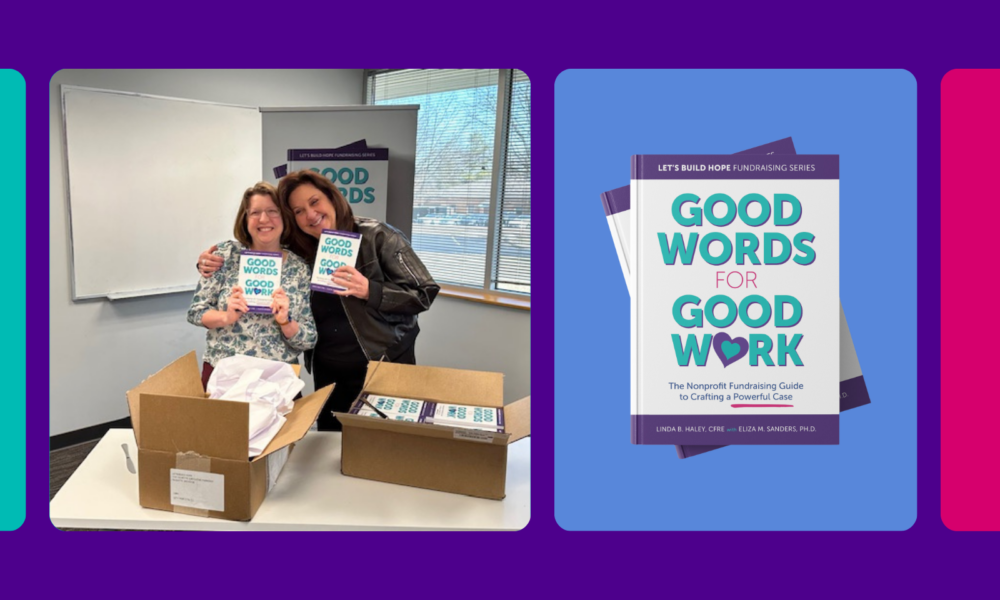
Learn more in the book Let’s Build Hope just released, Good Words for Good Work, which walks you through all the steps to develop your own Case for Why to help your staff, board, and donors, all feel—and successfully fundraise—together.
#LBH #GlimmersofHope #Blog #Book #CaseforWhy #GoodWordsforGoodWork